ERDYN US


With the adoption of the first five EDPCIs in September 2026, the European Union is gradually completing its framework for supporting the defence industry. Having developed tools to fund R&D through the European Defence Fund (EDF), and subsequently to support production and joint procurement through the EDIP, the European Union is now launching the European Defence Projects of Common Interest (EDPCI): large-scale collaborative industrial projects designed to develop military capabilities considered strategic at European level. Here are the key points to bear in mind.
What is an EDPCI?
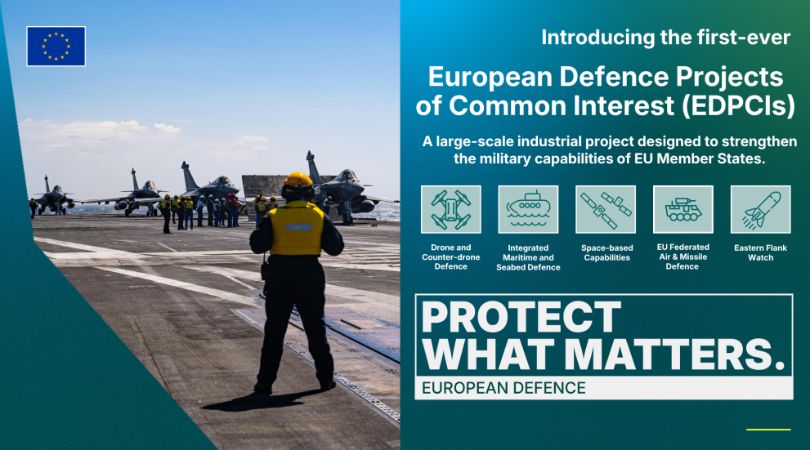
European Defence Projects of Common Interest (EDPCI) are large-scale collaborative industrial projects introduced by the EDIP Regulation.
Their aim is to enable several European states to jointly develop military capabilities deemed essential to the security of the Union, where their scale, cost or complexity justify cooperation at European level.
Unlike a traditional call for proposals under the European Defence Fund, an EDPCI does not therefore necessarily involve the development of a single technology or product. It may cover a much broader military capability, combining, for example, industrial development, increased production capacity, infrastructure and the joint procurement of equipment.
Why this programme, and why now?
For several years now, the European Union has been funding the joint development of defence technologies, notably through the European Defence Fund (EDF). However, one weakness remains: technology developed through European cooperation does not necessarily lead to joint production or procurement. Member States often continue to procure their equipment separately, which limits volumes, leads to a proliferation of standards and fragments the European industrial base. The EDPCIs seek to address this challenge by encouraging Member States to go further together: not only to develop a technology, but also to industrialise, produce, procure and deploy a common strategic capability.
How are EDPCIs selected?
The process is very different from that of a traditional call for proposals. Companies do not submit an application directly to have a project designated as an EDPCI. It is the Member States that coordinate and propose the projects. The Commission then assesses their compliance with the criteria set out in the EDIP Regulation and proposes to the Council those projects eligible for EDPCI status.
For the first round:
- The Commission launched a call for expressions of interest to Member States on 16 February 2026
- 9 projects were proposed
- 5 were selected by the Commission in July
- The Council officially approved them on 28 September 2026
Who receives the funding?
This is one of the main differences compared with traditional industrial EDIP calls. In activities specifically funded under the EDPCI, the direct beneficiaries may be: Member States, associated countries, or Structures for European Armament Programmes (SEAPs), i.e. joint structures set up by several States to manage European armament programmes. Companies are therefore not the direct beneficiaries of the EDPCI grants themselves. However, Member States or SEAPs will use this funding to implement the projects, which will generate contracts, development work and industrial orders.
What funding is available for EDPCIs?
The first five projects have been selected, each addressing a strategic priority identified at European level:
- DECODER – Drones and anti-drone systems: Development, production and deployment of drones and anti-drone solutions.
- IMSD – Maritime and seabed defence: Surveillance, detection and response to threats at sea and on the seabed.
- SPACE – Space defence: Early warning, satellite communications, ISR, positioning/navigation and rapid satellite replacement.
- EU-FIAMD – Air and missile defence: Integration of detection, warning, command and interception capabilities.
- Eastern Flank Watch – Protection of the Eastern Flank: A multi-domain approach combining land, air, maritime, cyber, mobility and anti-drone capabilities.
What are the terms and conditions of access?
At this stage, the operational arrangements for implementing the EDPCIs have not yet been fully defined: the detailed timetable, the organisation of the various industrial components, the procedures for selecting companies and the precise funding conditions still need to be clarified on a project-by-project basis. For manufacturers wishing to get involved, the first step is therefore to approach the participating states, the ministries of defence, defence procurement agencies and the prime contractors involved, who will play a central role in structuring and rolling out the projects.
EDPCI, EDIP, FED: how do you make sense of them all?
The three schemes are complementary. The FED remains primarily focused on collaborative research and development: the design of new technologies, prototypes, testing and qualification. The EDIP is more involved in the industrial phase: increasing production capacity, securing supply chains and supporting joint procurement. The EDPCIs are one of the EDIP’s tools: they enable these various initiatives to be brought together around major military capabilities shared by several states.
Erdyn supports you with your defence projects:
Erdyn has extensive experience with European defence schemes, in particular the European Defence Fund (EDF) and the EDIP. We have supported dozens of EDF projects since the programme’s launch, as well as several EDIP projects, assisting with the identification of relevant calls for proposals, the formation of transnational consortia, the drafting and optimisation of applications, and the monitoring of funded projects.
Would you like to assess your position regarding the EDIP or EDPCIs? Contact our teams to discuss this.
Sources :
- Règlement (UE) 2025/2643 – European Defence Industry Programme (EDIP)
https://eur-lex.europa.eu/legal-content/FR/TXT/?uri=OJ%3AL_202502643
- Commission proposes five joint defence projects to strengthen Europe’s industrial capabilities – 3 July 2026
https://defence-industry-space.ec.europa.eu/commission-proposes-five-joint-defence-projects-strengthen-europes-industrial-capabilities-2026-07-03_en
- Proposal for a Council Implementing Decision on the first EDPCI – EUR-Lex
https://eur-lex.europa.eu/legal-content/EN/TXT/?uri=CELEX%3A52026PC0358
- Council Implementing Decision (EU) 2026/2221 – First European Defence Projects of Common Interest
https://eur-lex.europa.eu/eli/dec_impl/2026/2221
- Industrie européenne de la défense : le Conseil identifie les cinq premiers projets d’intérêt commun – Conseil de l’UE, 28 septembre 2026
https://www.consilium.europa.eu/fr/press/press-releases/2026/09/28/european-defence-industry-council-identifies-the-first-five-projects-of-common-interest/
- European Defence Industry Programme (EDIP) – Conseil de l’Union européenne
https://www.consilium.europa.eu/en/policies/defence-industry-programme/