 ERDYN US


Europe is facing the most unstable security environment it has experienced in decades. In light of this, the European Union has implemented several measures in recent years to strengthen its defense industry. One of the most recent is the EDIP: European Defense Industry Program. Here are the key points to remember.
What is EDIP?
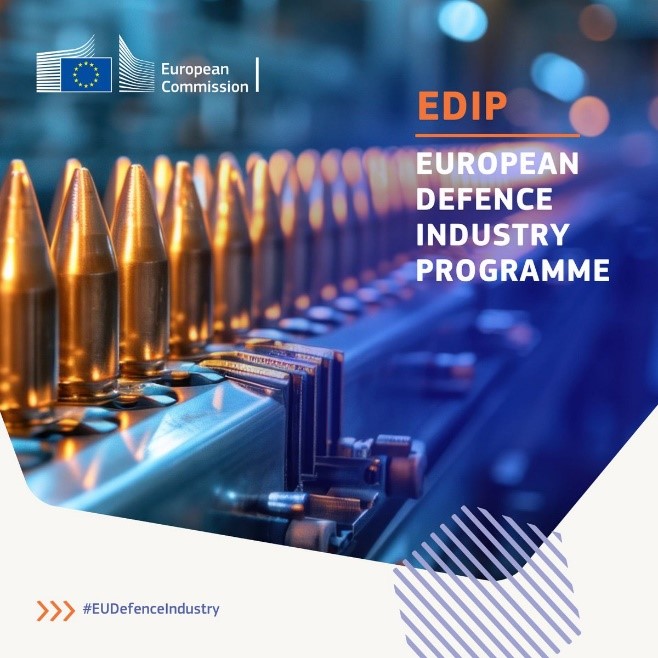
EDIP is a European program aimed at strengthening the European defense industrial and technological base (EDITB). It was adopted by the European Parliament and the Council in December 2025 and entered into force on December 30, 2025. The program runs through the end of 2027.
EDIP aims to increase the competitiveness and responsiveness of the European defense industry and to stimulate joint procurement. Specifically, it provides a total of 1.5 billion euros in grants, of which 300 million are allocated to a specific support instrument for Ukraine.
Why this program and why now?
The war in Ukraine and the general deterioration of the security environment have highlighted the urgent need to rebuild defense production capabilities in Europe. Furthermore, procurement of military equipment is still largely organized at the national level, which fragments the industry, limits economies of scale, and hinders interoperability among European armed forces.
The EDIP is part of a broader strategy led by the European Commission—namely, the European Defense Industrial Strategy (EDIS) and the Readiness 2030 initiative—which aim to prepare Europe for growing long-term defense needs.
The timing of the EDIP is significant: the two instruments that preceded it—covering joint procurement and ammunition production—expired at the end of 2025. EDIRPA, which funded joint procurement of military equipment among member states, ended on December 31, 2025. ASAP, a short-term program dedicated to ammunition production, was set to expire on June 30, 2025. The EDIP takes over from these two instruments, building on and expanding their approach.
The program builds on the European Defense Fund (EDF), but with one major difference: while the EDF primarily funded research and development, the EDIP goes a step further by directly supporting industrial production. This sends a clear message to companies in the sector: Europe is ready to co-finance your manufacturing capabilities.
What EDIP Funds:
The program is based on several complementary components:
- Strengthening industrial production capacity: grants to enable European (and Norwegian) manufacturers to increase their production rates.
- A framework for industrial cooperation with Ukraine: integrating the Ukrainian defense industry into European value chains, with a dedicated financial component of 300 million euros.
- A supply security scheme for products considered critical in times of crisis.
- A legal toolkit to facilitate long-term defense cooperation among Member States.
- Dedicated support for joint procurement: consortia of contracting authorities from several Member States (and Norway) may receive funding to pool their equipment purchases, for example in anti-drone defense, air and missile defense, or land and naval combat systems.
- The FAST Fund (Fund to Accelerate the Transformation of Defense Supply Chains), with a budget of 100 million euros, is designed to facilitate access to equity financing for startups, SMEs, and small and medium-sized enterprises in the sector.
EDIP, one tool among many: how to make sense of it all?
EDIP did not come out of nowhere: it builds upon and expands the approach of EDIRPA and ASAP, two programs that have now come to an end. It differs, however, from the European Defense Fund (EDF), which remains focused on research and development, prior to industrialization.
EDIP stands out for its ambition: it covers industrial ramp-up, joint procurement, cooperation with Ukraine, and security of supply within a single framework, with the aim of paving the way for even more ambitious instruments for the post-2028 period.
The first calls for proposals
The EDIP 2026–2027 work program was published on April 7, 2026, and the first four calls for proposals are now open. The IRA (Industrial Reinforcement Actions) component has a budget of over 700 million euros, divided among four calls: two for Member States and Norway, and two dedicated to Ukraine.
For Member States and Norway:
- Energy components: budget of €166.4 million, with an EU contribution capped at €30 million per project. Submission deadline: June 16, 2026.
- Key Electronic Components + Platforms and Finished Products: a dual call totaling €122.25 million (electronics, capped at €20 million per project) and €152.75 million (platforms, capped at €30 million per project). Joint deadline: February 16, 2027.
The EU funding rate for these two calls can reach 35% of eligible costs, or even 50% under certain co-financing conditions.
For Ukraine (the USI-IRA calls):
These calls aim to support the Ukrainian defense industry and facilitate cross-border cooperation with European companies. Here, the funding rate is significantly higher: up to 100% of eligible costs.
- Missiles, ammunition, and bombs: €180 million budget, with a cap of €30 million per project. Submission deadline: October 13, 2026.
- Drones and anti-drone systems: €80 million budget, with a cap of €10 million per project. Submission deadline: February 16, 2027.
Who is eligible?
The program is primarily aimed at European defense companies, both large and small, as well as transnational consortia of companies.
Ukraine and Norway are explicitly included in the program. Particular attention is given to SMEs and startups, notably through the FAST fund, as well as to the criteria regarding the origin of components: the regulation stipulates that the cost of components sourced from third countries may not exceed 35% of the total cost of a product supported by the EDIP.
Furthermore, funded projects must demonstrate genuine industrial scale. With a minimum investment threshold set at €2 million, the EDIP is not intended for exploratory or pre-seed phases, but is clearly aimed at supporting industrial ramp-up. Eligible expenses specifically concern productive investment (equipment, tooling, production lines) and do not include operating costs or basic research activities.
Erdyn supports you in your EDIP projects
At Erdyn, we support our clients in developing and submitting their EDIP projects: identifying relevant calls for proposals, structuring transnational consortia, drafting and optimizing application packages, and providing administrative and financial oversight of funded projects.
This expertise is backed by solid experience: recognized in the field for our support with the European Defense Fund (EDF), we have already managed dozens of EDF projects since the program’s launch. This experience naturally extends to EDIP, where we have already supported several projects, giving us a precise understanding of the evaluators’ expectations as well as the specific considerations unique to this program.
Do you have a project that might qualify for the EDIP? Contact our teams to discuss it.
Sources :
- https://armement.defense.gouv.fr/des-opportunites-pour-le-renforcement-industriel-publication-du-programme-de-travail-edip
- https://www.consilium.europa.eu/fr/policies/defence-industry-programme/
- https://www.touteleurope.eu/l-ue-dans-le-monde/qu-est-ce-que-le-programme-pour-l-industrie-europeenne-de-la-defense-edip/


